
Where Oconee County Crime News Appears
The Oconee Enterprise has a real arrest-photo history. Its crime section runs event-driven stories online, and the weekly print edition has carried a recurring arrest-photo feature. Coverage draws on OCSO incident reports, JailTracker, Georgia State Patrol and GBI releases, and later court reporting. Helpful as that mix is, it still reflects an editor's choices.
Regional outlets add another layer. Classic City News, OnlineAthens, and the Athens Banner-Herald cover the area selectively. Oconee Patch holds an older police and fire archive, including the historical "Oconee Docket Book." None of these is a live Oconee booking feed. A Watkinsville incident might land under a city label, a countywide one, or an Athens-area tag. Confirm the arresting agency and county before matching a story to a roster entry.
News coverage is selective by nature. A story reflects what an agency reported or what an editor chose to print at the time.
Oconee Outlets and Their Records
Each outlet has its own scope and photo practices. The table below puts official source links and local reporting first. County-grouped commercial pages come after them. Publisher policies shift, so read any disclaimer on the page you're actually using.
| Outlet | Coverage | Photos? | Where to look |
|---|---|---|---|
| Oconee Enterprise | County-local, event-driven online crime stories and a weekly print paper | Recurring print arrest-photo feature is documented; online selection varies | Crime category and print issues |
| Classic City News | Selective Metro Athens reporting, including some Oconee cases | No complete Oconee booking gallery verified | News categories |
| Oconee Patch | Historical sheriff and police/fire archive | Older blotter material may include booking references | Police and fire archive |
| OnlineAthens / Banner-Herald | Occasional regional crime or court reporting | No verified county landing page | Use a directly verified story, not a search snippet |
| Busted Newspaper | Unofficial county-grouped booking cards and deep archive | Publisher thumbnails where supplied | Oconee County page |
| Recently Booked | Unofficial publisher claim of a rolling county view | Publisher says Oconee does not provide images | Oconee page |
| Mugshots.com / Arrests.org | Unofficial historical or current-style county pages | Publisher images or cards may appear | Mugshots.com archive and Arrests.org |
County-grouped publishers bring their own problems. They can mix agency labels, run old dates, or even point to the wrong Oconee County. Treat them as leads toward a source URL, not as proof of current custody. The Enterprise, OCSO, and the relevant court come first.
The Oconee Enterprise Arrest Tradition
The Enterprise's habit is more specific than a blanket "crime news" label. A December 2023 notice told readers one issue would skip arrest photos and related information, with double the material returning the next week. A 2020 scan hosted by Georgia Historic Newspapers tells more. Its "ARRESTS" panel came straight from the jail arrest book, complete with headshots, municipalities, and charges.
That supports calling it a recurring print feature, not a guarantee that every arrest appears each week. A print panel can lag behind a jail entry. It can leave someone out entirely. The historic scan is an archive example, not a source for who is in custody now.
How Oconee Booking Photos Reach News
Where does a booking photo in the news actually come from? Sometimes an agency release. Sometimes a records request, or a jail arrest-book reference, or an image passed along a publisher's own chain. Georgia's public-records law opens a path to these records, but it can't force an outlet to publish every image or make an agency build a new compilation. OCSO's request form asks for a record description, date or time, case number, and name. Ask the sheriff directly when the jail holds an existing photograph.
Whether the Oconee JailTracker interface displays photos is an open question. The county wrapper posts no clear policy. The vendor panel itself has rendering problems. Recently Booked claims Oconee doesn't provide images, though that's a third-party statement. A publisher thumbnail proves nothing about what OCSO released or who remains in custody.
Seeking a correction? Identify the exact article or image URL and attach the court or agency document backing the change. Record restriction or a favorable outcome can affect some publisher processes. Still, it won't automatically wipe a news archive or every copy sitting in a search result.
From Oconee News to the Official Record
A story earns its keep when it names the agency, the date, the location, or the charge. Each record works best in its own lane. The news points you somewhere. The official files confirm it.
- Save the article URL and publication date. Note the named agency and whether the story says OCSO, Watkinsville Police, GSP, GBI, or another source.
- Check OCSO's Current Inmates search only for intended present county-jail custody. A person may have been released or transferred.
- For a released booking, request the existing OCSO booking record and photograph with the arrest date, agency, name, and case number.
- Use the proper court clerk or Georgia Courts e-access path for the filed case and later disposition.
- Label the article's charge as an charge at the time of booking and separate any later court result by date.
A news story can't replace a court disposition. When a docket and an article disagree, the docket's dated result is the later record. The story then stays shelved as a snapshot of what was known at publication. If the person later moves into state custody, the Georgia Department of Corrections keeps that offender record, not the Oconee County Jail.
Oconee's Older Blotter Archives
Oconee Patch's police and fire archive rewards anyone digging into local history, though its material clusters in older years, especially 2011 through 2016. Its February 2013 "Oconee Docket Book" entry lists names, municipalities, and charges, citing the Oconee County Jail as its source. Don't ask the archive who is in jail today. It can't answer that.
The Patch police and fire archive demonstrates the older local blotter pattern.
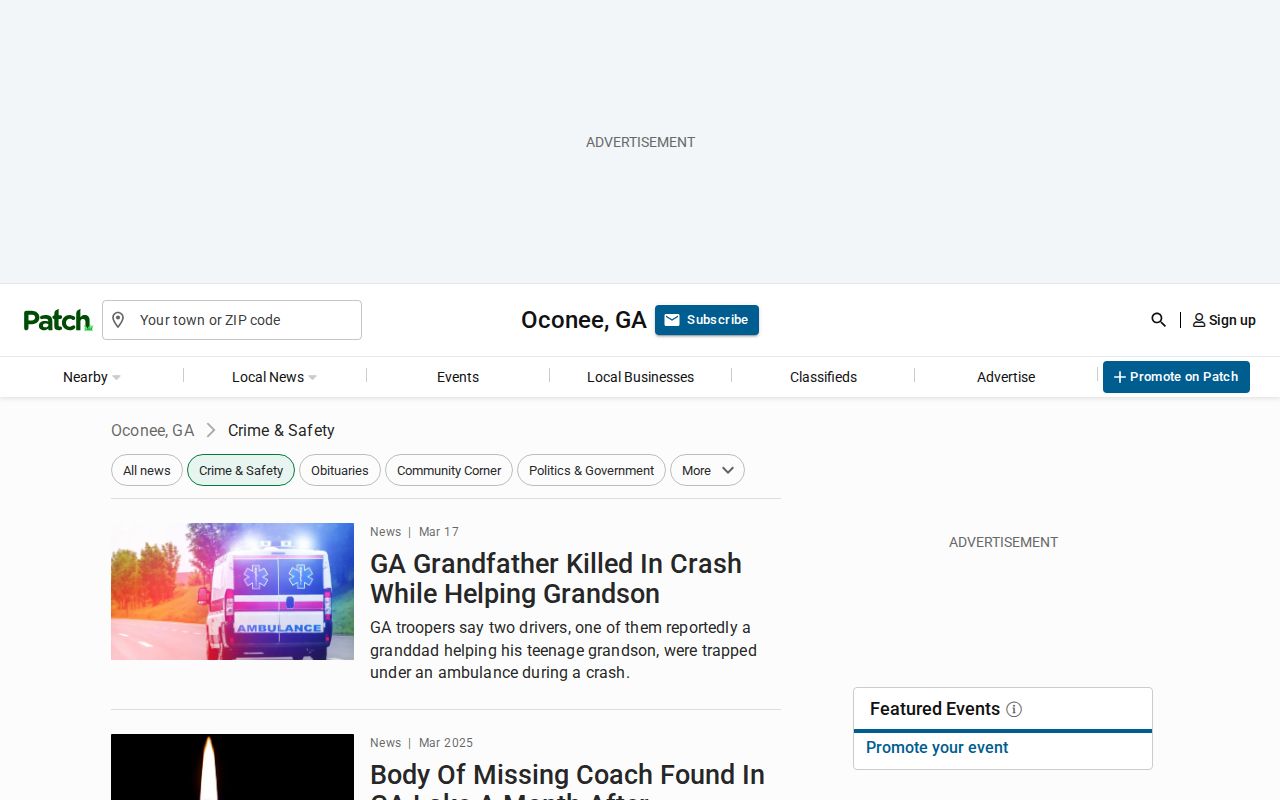
The archive screenshot serves as an interface reference only. It doesn't rehost anyone's image, and it shouldn't be mistaken for a current roster or a complete arrest record.
Oconee Third-Party Mugshot Pages
Oconee's third-party busted-mugshot sites each take a different approach. Busted Newspaper prints booking cards with date, agency, charges, and bond when those fields exist. Recently Booked promises a thirty-day rolling view and frequent refreshes. Oddly, the same site admits Oconee supplies no booking photos. Mugshots.com skews toward older material and lets you browse by first initial and arrest year. Arrests.org sorts cards by publisher and by county group.
That variety is exactly why caution pays off. A site can look current while its newest Oconee entry is months old. A copied charge may never show the later court result. Check the county label, the Georgia agency named, the visible date, and any source disclaimer before relying on anything. Never treat an unofficial page as proof that someone sits in jail, has a live warrant, or was convicted.
Where you look matters. OCSO and the court come first. Local news adds reporting context. Commercial county pages rank last, since their material runs secondary and can go stale.
City Crime News in Oconee County
The Enterprise covers Watkinsville, the Oconee side of Bogart, and the North High Shoals area better than any other local outlet. Its stories are grouped county-wide, though, not sorted by city. Watkinsville police activity shows up in monthly council packets. Those reports give aggregate numbers, not named booking entries. A Bogart story needs its county-line boundary confirmed before you assign it to OCSO. North High Shoals has no town blotter that could be located.
For city-level custody records, start with the Watkinsville Busted Mugshots page, then contact the right city record custodian. One caution: a municipality label on a story hints at the arresting agency but proves nothing about which county booked the person.
Oconee Crime News Source Mix
Read an Enterprise story's sourcing closely and you can tell what kind of record it describes. Attribution to an OCSO incident report means an agency account of an event. A JailTracker reference points to custody data. A GBI or GSP release reflects that agency's own investigation. Later court coverage may carry the outcome. Lumping all of these into "the police record" loses the distinctions.
OCSO's Community Engagement channels post alerts, tips, and selected public-safety updates. A social post is not a durable booking feed, and Facebook material can be corrected or deleted without notice. Nixle sends event notices but skips charge and bond fields. For present custody, use the county Current Inmates page. For a released booking, OCSO's records unit is the formal route.
| Story clue | Record to verify next |
|---|---|
| OCSO incident report | OCSO custody or records request |
| JailTracker reference | Current Inmates, checked on its access date |
| GSP or GBI release | Named state-agency source and the matching court case |
| Court story | Official docket or clerk response for the dated result |
Correcting Oconee Crime Coverage
Fix a factual mistake at the outlet that published it. Save the article or image URL first. Pin down the exact error. Then attach the agency or court document that proves the correction. An OCSO field error calls for a precise request to the sheriff establishing the official record. A court-outcome error is best answered with a dated docket or a clerk's response, which carries more weight.
Georgia record restriction and a favorable outcome can shape what publishers must do, but neither wipes out every news copy or search result automatically. The source page itself has to change before Google's outdated-content process will refresh the listing. News archives also follow editorial and legal rules of their own, which rarely match a commercial county page's practices.
Keep the timeline in view. A story can accurately report a booking on its publication date and still read as incomplete after the court resolves the case. The fix is adding the later disposition, not rewriting the original.